Рубрика «fpga» - 18

Abstract

Linear feedback shift registers are an excellent tool for implementing a pseudo random bit generator in hardware; they inhibit a simple and efficient electronic structure. Further, they are capable of producing output sequences with large periods and good statistical properties. However, standard LFSRs are not cryptographically secure, since the output sequence can be uniquely predicted given a small number of key stream bits using Berlekamp-Massey algorithm. Several methods have been proposed to destroy the linearity inherent in LFSR design. These methods include nonlinear combination generators, nonlinear filter generators, and clock controlled generators. Nevertheless, they remain vulnerable to many attacks such as side channel attacks and algebraic attacks. In 2015, a new clocked controlled generator, called the switching generator, was proposed. This new generator has been proven to be resistant to algebraic attacks and side channel attacks, while preserving efficiency and security requirements. In this project, we present a design of the switching generator using Verilog HDL.
Читать полностью »
Introduction

Our project implements a real-time edge detection system based on capturing image frames from an OV7670 camera and streaming them to a VGA monitor after applying a grayscale filter and Sobel operator. Our design is built on a Cyclone IV FPGA board which enables us to optimize the performance using the powerful features of the low-level hardware and parallel computations which is important to meet the requirements of the real-time system.

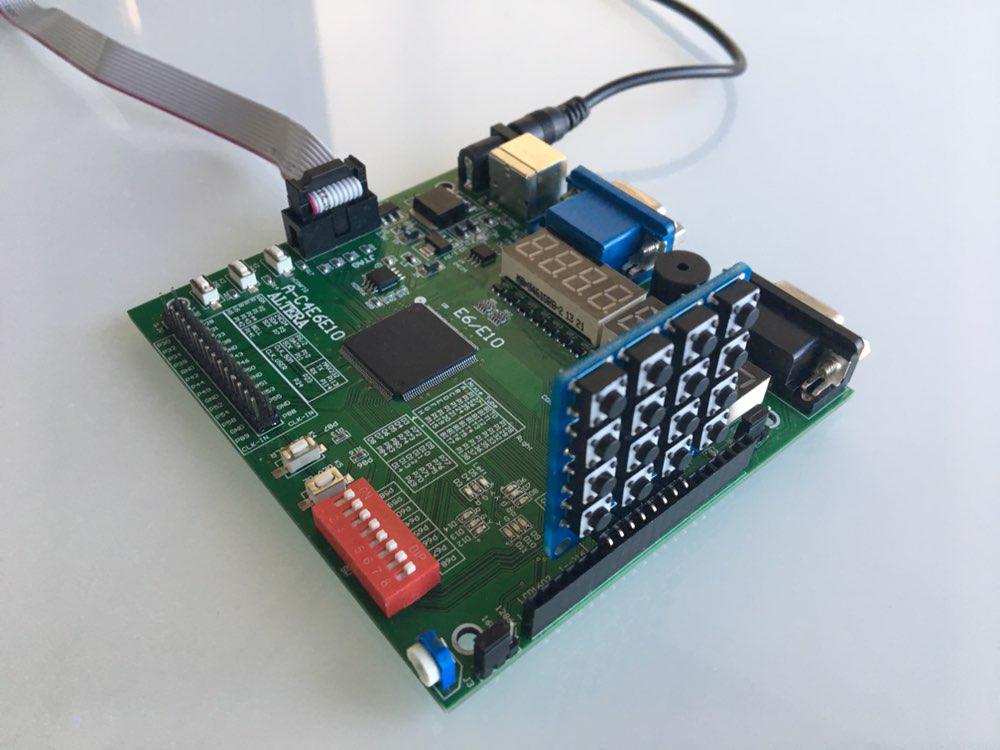
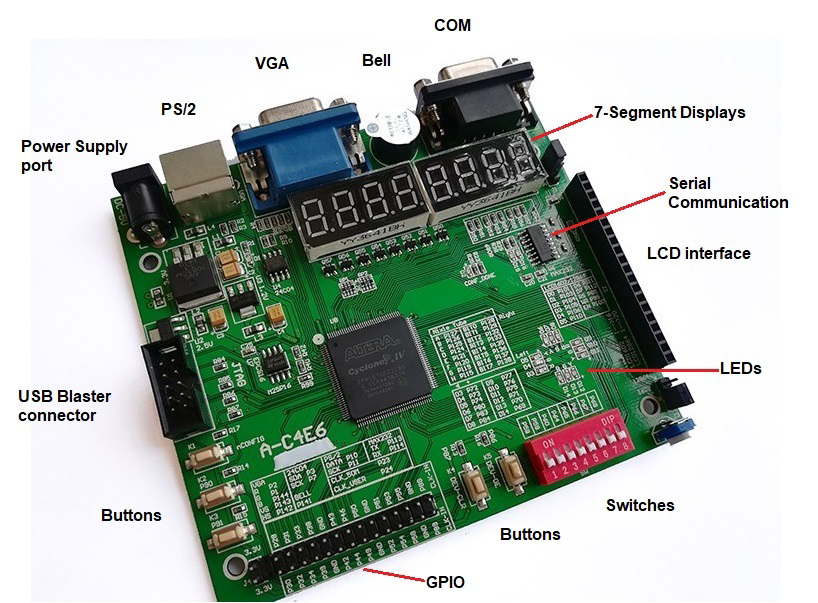
We used ZEOWAA FPGA development board which is based on Cyclone IV (EP4CE6E22C8N). Also, we used Quartus Prime Lite Edition as a development environment and Verilog HDL as a programming language. In addition, we used the built-in VGA interface to drive the VGA monitor, and GPIO (General Pins for Input and Output) to connect the external hardware with our board.

ZEOWAA FPGA development board

Читать полностью »

Introduction

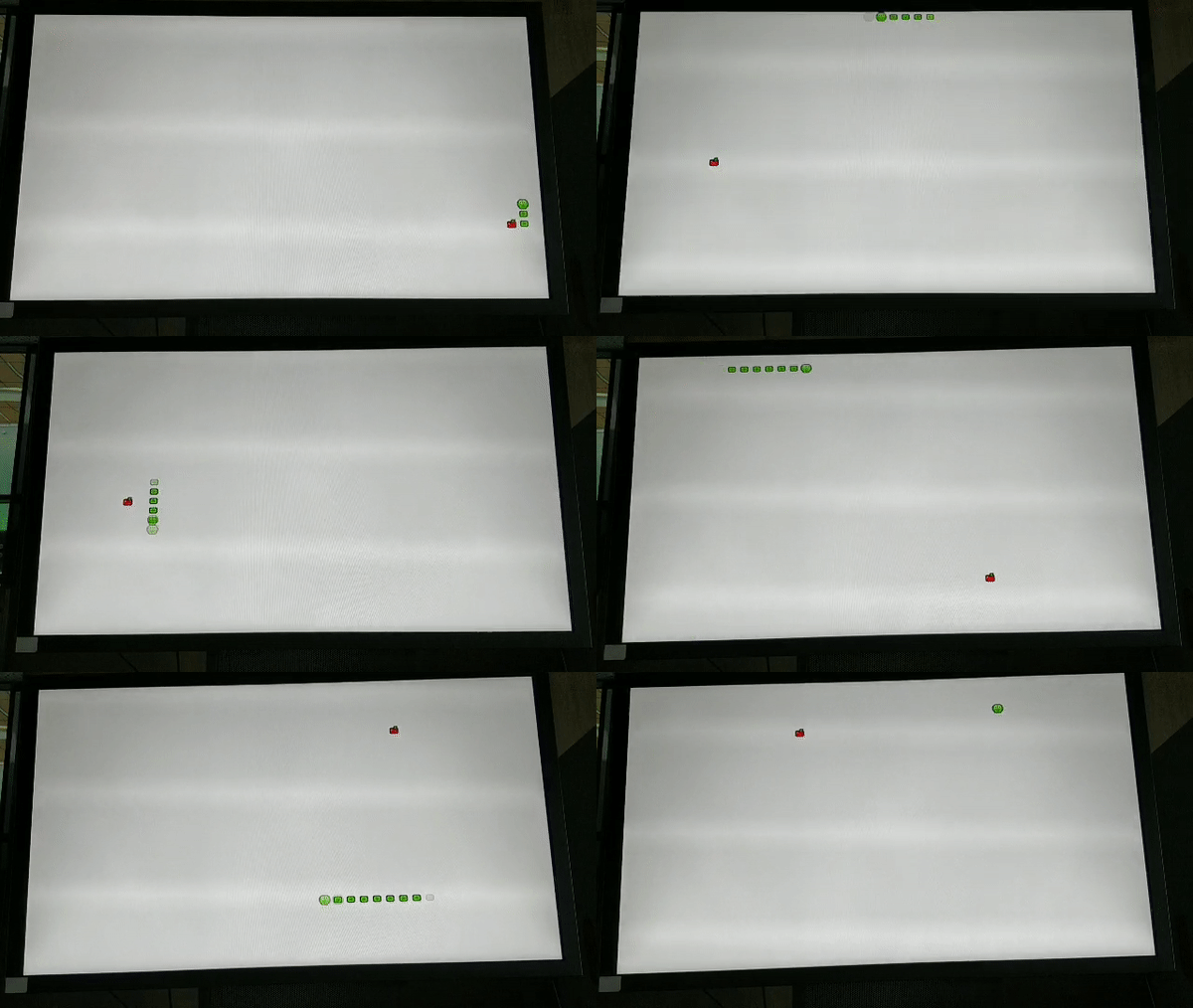
Do you remember the snake game from childhood, where a snake runs on the screen trying to eat an apple? This article describes our implementation of the game on an FPGA1.

Gameplay.gif
Figure 1. Gameplay

Читать полностью »

Здравствуйте! В этой статье я расскажу какие шаги нужно пройти для создания простого процессора и окружения для него.

Читать полностью »

Возникал ли у вас когда-нибудь вопрос "как работает процессор?". Да-да, именно тот, который находится в вашем в ПК/ноутбуке/смартфоне. В этой статье я хочу привести пример самостоятельно придуманного процессора с дизайном на языке Verilog. Verilog — это не совсем тот язык программирования, на который он похож. Это — Hardware Description Language. Написанный код не выполняется чем-либо (если вы не запускаете его в симуляторе, конечно), а превращается в дизайн физической схемы, либо в вид, воспринимаемый FPGA (Field Programmable Gate Array).

Читать полностью »

в 17:36, , рубрики: fpga

Introduction

We have created a synthesizable verilog code for calculating an integer cube root of an integer number via binary search algorithm. This code had been tested on Cyclone IV FPGA board. Here you can read about implementation and understand how things works.

Github link: Cube root
Читать полностью »

Introduction

As first-year students of Innopolis University, we had an opportunity to make our own project in computer architecture. University suggested to us several projects and we have chosen to make a stack-based calculator with reverse polish notation. One of the requirements for the project is to use FPGA board provided by the university.

Stack-based calculator on the Cyclone IV FPGA board - 1

As our board, we have chosen Cyclon IV. Therefore, we had to write code on hardware description language. In the course we have studied Verilog, so we have chosen it. Also, the university has additional modules for FPGA, such as numpad, thus we decided to use it in our project.

In this article, we want to share our knowledge about FPGA and Verilog, also provide you with a tutorial to repeat our project.
Читать полностью »

Игра Жизнь — всем известный клеточный автомат, изобретенный Джоном Конвеем в 1970 году. Суть игры заключается в симуляции «вселенной», в нашем случае реализованной на квадратной матрице 8х8 с замкнутыми краями.
Читать полностью »

Загрузка конфигурации в ПЛИС через USB или разбираем FTDI MPSSE
Пишем загрузчик ПЛИС в LabVIEW. Часть 1

Пишем загрузчик ПЛИС в LabVIEW. Часть 2 - 1

В первой статье мы обкатали алгоритм загрузки на старом добром Си, во второй статье разобрались, как в LabVIEW можно организовать программу и реализовать простой интерфейс пользователя. В этот раз мы познакомимся с новыми приемами работы в LabVIEW, разберем особенности обработки ошибок и завершим проект: реализуем протокол загрузки файла конфигурации в ПЛИС.Читать полностью »

Пишем загрузчик ПЛИС в LabVIEW - 1

У большинства "нормальных" программистов, мягко говоря, неоднозначное отношение к технологии LabVIEW. Тут спорить можно долго и безрезультатно. Ситуацию усугубляет то, что в сети масса примеров программ на LabVIEW, но все они ориентированы на новичка и сводятся к "ой, смотрите как все просто, соединил крутилку с индикатором, кручу ручку, меняется циферка", или в лучшем случае на график в цикле выводится случайное число или синус, все это сопровождается зубодробительным интерфейсом в виде гигантских тумблеров, крутилок и стрелочных индикаторов. Лично меня такой подход сознательного упрощения раздражает. В небольшом цикле статей я постараюсь познакомить читателя с процессом разработки прикладного ПО на LabVIEW. Для того, чтобы не уделять много времени предметной области, воспользуемся подробно описанным алгоритмом загрузки файла конфигурации в ПЛИС через FTDI в режиме MPSSE (Загрузка конфигурации в ПЛИС через USB или разбираем FTDI MPSSE). В этой статье я покажу как реализовать такой же загрузчик ПЛИС, но на языке LabVIEW.

Читать полностью »


https://ajax.googleapis.com/ajax/libs/jquery/3.4.1/jquery.min.js